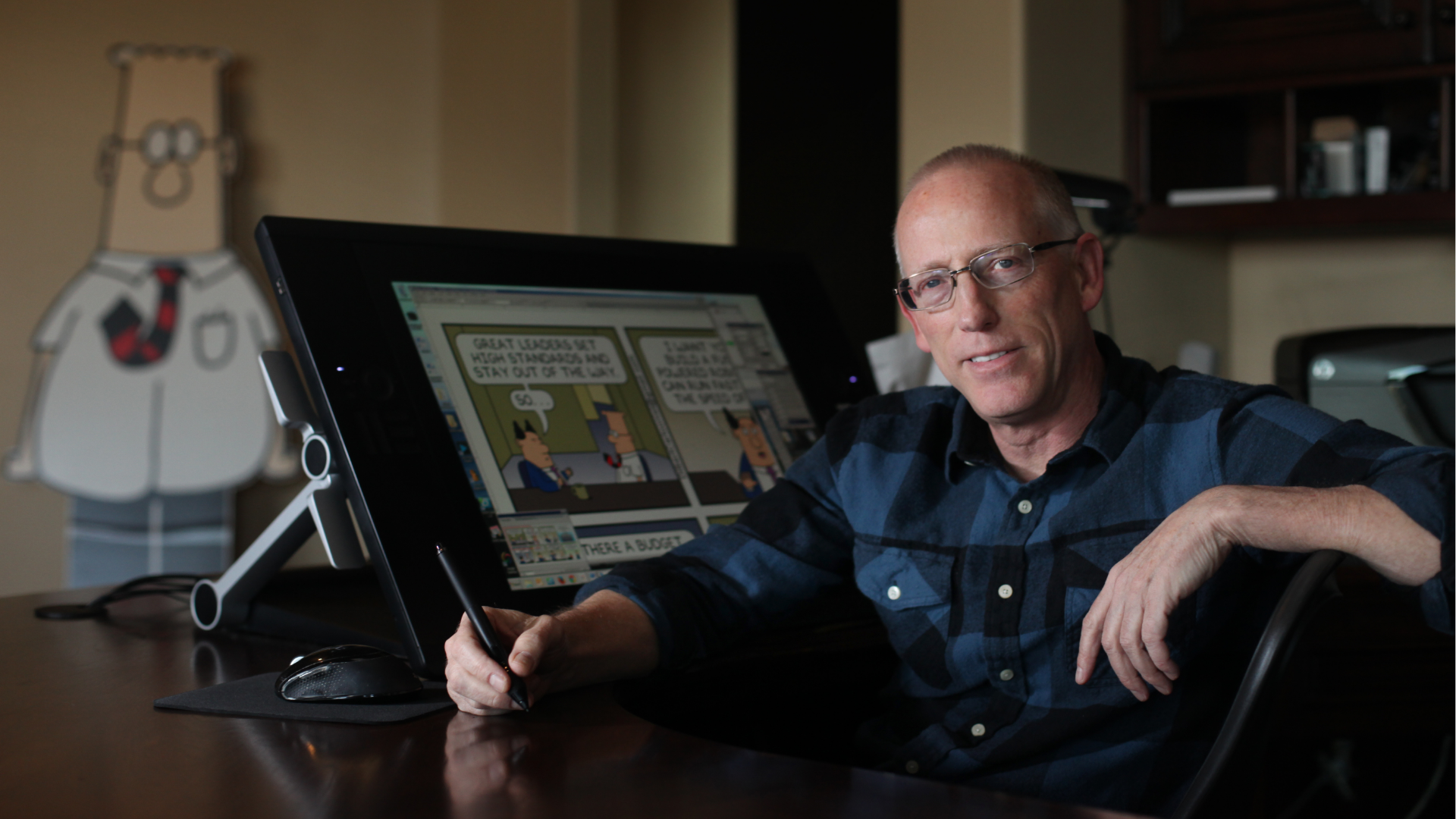
Scott Adams, the brilliant mind behind *Dilbert* and a tireless explorer of persuasion, systems, and human behavior, left this world on January 13, 2026, at age 68 after a fierce battle with metastatic prostate cancer.
In his final months, he faced declining health with the same clarity and directness that defined his career—sharing updates on his “Real Coffee with Scott Adams” livestreams even from hospice care, paralyzed below the waist yet still mentally sharp until the end.
What stands out most about Scott’s last days isn’t just the physical struggle, but the profound reflections he shared. On New Year’s Day 2026, he wrote a final message (later shared publicly by his ex-wife Shelly Miles), where he announced a personal shift: the longtime agnostic took Pascal’s Wager and declared, “I accept Jesus Christ as my Lord and Savior, and look forward to spending an eternity with him.” He acknowledged the uncertainty with his characteristic humor and pragmatism, noting it would be “quickly resolved if I wake up in heaven.”
In that same letter, Scott looked back on his life and career with gratitude and purpose. He described evolving from a cartoonist satirizing corporate absurdities to someone focused on creating “useful” books—like *How to Fail at Almost Everything and Still Win Big*, *Win Bigly*, and *Loserthink*—to help people live better, think clearer, and persuade more effectively. He wrote: >
“I had an amazing life. I gave it everything I had. If you got any benefits from my work, I’m asking you to pay it forward as best you can. That is the legacy I want. **Be useful.**”
Those two words—”Be useful”—echo through his final thoughts like a parting gift. Scott spent decades teaching systems over goals, talent stacking, energy management, and seeing reality through clearer filters. In his end, he modeled something even more powerful: facing mortality without panic, finding meaning in contribution, and urging others to keep adding value to the world.
His journey wasn’t without controversy or pain—personal losses, career backlash, and a brutal illness tested him—but he remained consistent. He showed us how to live intentionally, adapt relentlessly, and exit with dignity. As one observer put it, he taught us how to understand the world, how to live, and finally, how to die well.
Scott’s legacy isn’t just in the laughs from *Dilbert* or the mind-shifts from his books and streams. It’s in the reminder that a life well-lived is one spent being maximally useful to others. Pay it forward—because that’s exactly what he asked.
Rest in peace, Scott. You were useful to so many.
Related reading
- The Gap Between Who You Are and Who You Want to Be
- How I Define Best Version of Yourself
- Why Most Self-Improvement Advice Fails
David Daniels has been writing at DavidDaniels.com since 2001. Download the free life planning workbook, Write Open Act, to start mapping the gap for yourself.
One response to “Navigating failure, ambition, the absurdities of life and more…”
[…] Earlier this year I wrote about Scott Adams. You can find that post here… […]