I graduated high school in June of 1989. A few weeks later, on July 18, Rebecca Schaeffer was murdered at her front door in Los Angeles.
If you’re my age, you might remember her the way I do — as Patti Russell on My Sister Sam, the CBS sitcom that ran through my last years of high school on Long Island. It was my favorite show. She played the kid sister who moves in with Pam Dawber’s character and turns her life upside down, and she was funny in that effortless way that makes you assume you’ll be watching someone for the next thirty years. The show was set in San Francisco, too, which mattered more than it sounds — in the late ’80s, San Francisco was the place to be. The 49ers were winning Super Bowls, and that fall the A’s and Giants would face each other in the World Series across the bay. Even from a living room on Long Island, the whole city glowed. Watching the show felt like being let in on a life you wanted.
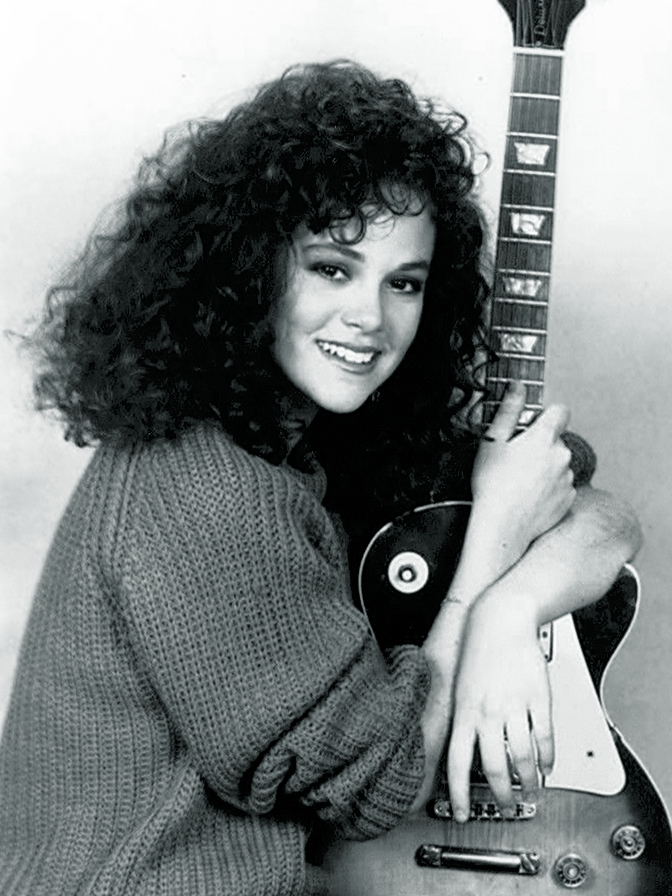
She was 21 when she died. I was 18. That’s not a celebrity’s age. That’s the age of somebody a couple grades ahead of you — close enough that it didn’t feel like losing a star. It felt like losing someone from the neighborhood.
I remember the strangeness of how the news arrived, because of how it couldn’t arrive. There was no push notification. No trending topic. No comment section filling up with people who loved the same show I did. The news came the way news came in 1989: the evening broadcast, the next morning’s paper, maybe a segment on Entertainment Tonight. And then it just — sat there. Inside you. There was nowhere to put it. No place to find the other people who’d watched her every week and felt like they knew her. Here was an actress who was suddenly gone out of my life just as I was starting mine — I was spending that summer getting ready for college, packing up my bedroom, standing at the very beginning of everything, and she didn’t get a beginning at all. You grieved alone, quietly, and eventually the summer moved on and so did you, whether or not you were finished.
That was pre-internet grief. Private. Unarchived. Unresolved.
I’ve been thinking about her again because today marks 37 years, and because of something that only recently started to bother me about how the story actually happened.
The $250 question
Here’s the part of the case that has aged worse than anything else.
The man who killed her had been fixated on her for about three years. He wrote her letters. She’d been warned by people around her not to answer fan mail — Pam Dawber, her My Sister Sam co-star, who’d had a stalker scare of her own, had cautioned her about the small ways a fan could find you, right down to keeping her real name off her mailbox. But it was in Rebecca’s nature to be kind. She answered one of his letters anyway — one small, human, generous gesture, the kind of thing you’d hope a young actress would do for a fan. And when letters weren’t enough, he needed her home address.
In 1989, that was genuinely hard to get. He couldn’t search for it. There was no search. So he paid a private investigator $250, and the investigator got the address the way anyone could back then: from the California DMV, which at the time would hand over a registered driver’s home address to essentially anyone who asked and paid a small fee.
Think about the friction in that sentence. He needed money. He needed an intermediary. He needed a government office with a paperwork process and a turnaround time. The world put real obstacles between an obsession and a doorstep — not because anyone designed it that way, but because information was simply heavy back then. It lived in filing cabinets. Finding someone required effort, and effort was a filter.
Her death broke that system open. California restricted DMV record access. The state passed the nation’s first anti-stalking law in 1990 — Penal Code Section 646.9, which for the first time made stalking itself a crime — and the ripples eventually reached Washington in the form of the federal Driver’s Privacy Protection Act of 1994. Neither law bears her name, but her name is all over the legal history of privacy in this country — a legacy no 21-year-old should have to leave.
Ninety seconds
And yet here’s what I keep circling: we closed that one loophole and then spent the next 37 years voluntarily building a thousand bigger ones.
It is amazing how much information we can now find on people. I mean that word literally — it amazes me, the way a magic trick amazes you right up until you learn how it’s done. What took an obsessed man three years, $250, and a private investigator in 1989 takes about ninety seconds and a data broker website today. Addresses, phone numbers, relatives, past addresses, the works. For anyone. For free, or close to it. And that’s the old way. Now you don’t even have to do the searching yourself — you can ask Grok or any other AI to run a deep search, and it will happily play private investigator for you. The $250 middleman didn’t just get cheaper. He got automated.
I’m an indie web guy at heart. I believe you should own your platform, publish your own words, control your corner of the internet — I’ve built this whole site on that idea. But the same revolution that gave me my blog also quietly repealed the physics that used to protect people like Rebecca Schaeffer. The friction is gone. Nobody voted on it. It just evaporated, one convenient service at a time, and we noticed the convenience but not the cost.
The world of 1989 failed her twice, in a way — it couldn’t give the rest of us anywhere to grieve together, and it couldn’t keep her address out of a stranger’s hands. We fixed the first problem completely. There is now infinite room to mourn in public. And we made the second problem catastrophically, permanently worse.
What friction was for
I don’t have a tidy call to action here. You can’t un-invent the people-search site any more than you could un-invent the filing cabinet.
But I think there’s something worth sitting with, especially for those of us who remember both worlds. Privacy used to be the default, not a setting. It wasn’t a virtue anyone practiced; it was just the natural state of information that was too heavy to move. Every year since 1989, we’ve traded a little more of that weight away for speed, and the trade always looks free in the moment.
Rebecca Schaeffer would be 58 now. She was three months from auditioning for The Godfather Part III when she died — the Mary Corleone role, the part Winona Ryder was later cast in before dropping out. Sit with that for a second. She was one audition away from a Coppola film at 21.
I sometimes play out the career she didn’t get to have. The honest comparison is Julia Roberts — born the same year, 1967, with that same warm, open, girl-next-door magnetism, and standing at almost the same spot on the ladder. Pretty Woman came out eight months after Rebecca died. That’s the lane she was in: sitcom kid graduating to films, directors already noticing her, the early-’90s wave of leading women — Roberts, Ryder, Marisa Tomei, Sandra Bullock — cresting right as she would have hit her stride. Maybe she becomes one of those household names. Maybe she becomes a beloved character actress instead, the kind who shows up in something great every few years and makes it better. There’s no version of it that’s small. Every path from where she was standing in July of 1989 led somewhere.
I think about the version of the world where the DMV clerk said no, where the address stayed in the filing cabinet, where the friction held — and she’s still here, and she had that career, whichever one it was, and she’s just an actress I used to watch in high school, and this post doesn’t exist.
I’d trade every ninety-second search I’ve ever run for that world.
—
If you remember My Sister Sam — or if you remember where you were that July — I’d genuinely love to hear about it. That’s what the reply button is for. It’s the one thing the internet got right.
David Daniels has been writing at DavidDaniels.com since 2001. Download the free life planning workbook, Write Open Act, to start mapping the gap for yourself.