A few weeks ago I followed a link to what looked like a personal site. Someone writing up a hike, a handful of photos, the kind of small unimportant page I used to stumble onto all the time and almost never find anymore. I was a paragraph or two in before I understood that nobody had written it. The photos were generated. The sentences had that smooth, agreeable smoothness that machines produce when you ask them to sound like a person and they oblige without ever having been one. I closed the tab.
What I felt wasn’t anger, exactly. It was closer to the feeling of walking through a town you grew up in and finding the corner store has become a place that sells nothing, staffed by no one, open all night for reasons that have nothing to do with you. The lights are on. The shelves are stocked. But it isn’t for people anymore, and on some level it knows that, and so do you.
There’s a name for that feeling now. People call it the Dead Internet Theory.
It started, as these things do, in a corner of the web most people never visit — a long post on a small forum in early 2021, arguing that the internet had quietly died sometime around 2016, that the humans had mostly left, and that what remained was bots talking to bots while the rest of us scrolled past, mistaking the motion for life. The Atlantic picked it up that fall and landed on a verdict I’ve never quite been able to shake: that it was absurd, and also maybe not absurd enough to dismiss.
I want to be careful here, because the theory comes in two strengths and only one of them is worth your time. The strong version is a conspiracy — that governments and corporations engineered all of this on purpose, to pacify you, to sell to you, to manage what you’re allowed to think. I don’t believe that, and I’d encourage you not to either. There’s no committee. There’s no plan that coherent.
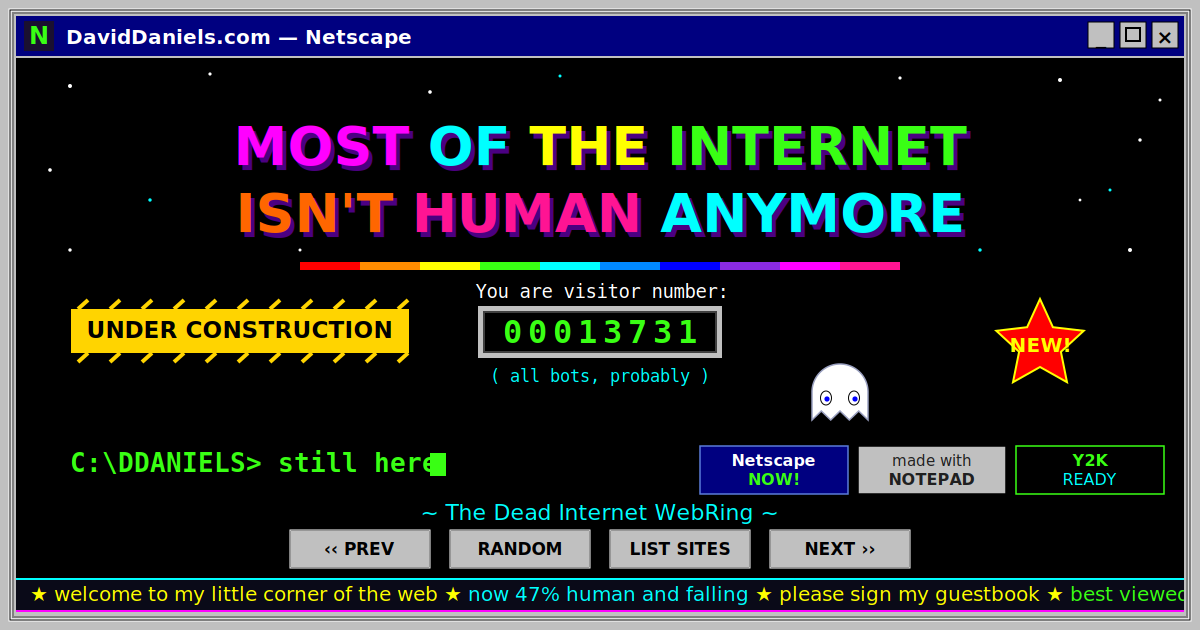
But underneath the conspiracy is a plainer observation, and the plainer observation has gotten harder to argue with every year. It’s just this: a great deal of what moves across the internet was not made by anyone.
For a long time that was a feeling you couldn’t prove, the kind of thing you’d mutter and then talk yourself out of. Then the people who count this sort of thing started counting. The security firm Imperva, which has tracked automated traffic for over a decade in a report so dry it could not possibly be accused of hype, found that in 2025 more than half of all web traffic — fifty-three percent — was machines. The year before it was fifty-one. Human activity is now the minority share of the thing we built for humans, and the line is still moving in the same direction. There’s a newer category in the data, too: not just bots and crawlers but agents, software that logs in and fills out forms and makes purchases the way you would, on someone’s behalf, through the same doors that were cut for us.
I don’t think the internet died. I think it got industrialized, which is a slower and less dramatic thing, and in some ways a sadder one. The handmade web didn’t vanish in a catastrophe. It just stopped being economical. Writing something yourself, slowly, because you had something to say, became the digital equivalent of churning your own butter — still possible, still nice, but no longer how the work gets done. Human writing is quietly becoming a premium good, the way anything becomes premium once a machine can approximate it for free.
The part that stays with me is watching the people who built the social web start to admit it. The man who runs the company most responsible for the flood has shrugged online that there really do seem to be a lot of machine-run accounts now. One of Reddit’s founders said he’d believed in the dead internet for a while. And then he and a partner tried to relaunch Digg — an honest attempt to rebuild a place for actual people, by men who knew exactly how that’s supposed to work — and within a couple of months they paused it, overwhelmed by bots, before bringing it back as something more automated than what they’d set out to make. Two people who understood the old web better than almost anyone tried to light the fire again, and couldn’t keep the machines out of it.
I keep coming back to my own corner of all this, which is small and probably doesn’t matter to anyone but me.
Even that corner wasn’t spared. Not long ago I went through the email list I’d built up over the years and realized more than half of it wasn’t real — bots, junk signups, addresses that belonged to no one. I cut it down by more than half in an afternoon. What I keep turning over is how I found them: I used an AI to flag the fakes, because it could see the patterns faster than I ever could by hand. The same kind of technology that’s filling the web with ghosts was the thing that told me which of my readers were human.
What I didn’t expect was that, somewhere in the last few years, keeping an ordinary personal site online would start to feel like a position — a small act of resistance, not because I changed but because the ground shifted underneath me. The thing I was already doing became rare, and rare things accidentally become statements.
So I find a lot of hope in the part of this story that doesn’t get told as often. There’s a revival happening — people building hand-coded personal sites again, joining webrings, hosting their own words on platforms that owe nothing to any feed. What gets me is who’s doing it. A lot of them are young, too young to remember the web I’m nostalgic for. They aren’t returning to anything. They’re building it from photographs, treating a clumsy 2003 homepage the way you might treat an old folk song — something worth learning by ear because the people who made it meant it. The web they want is one they never got to have, and they’re making it anyway, by hand, on purpose.
That’s the thing the theory misses. The human internet isn’t dead. It got quiet, and it got small, and small is where it was always best — in the personal pages, the unprofitable corners, the places run by one person who simply wanted them to exist.
I’ll keep mine lit. It was never about being seen by everyone. It was about being, unmistakably, a person, in a place that’s getting harder to fake.
Still here.
— David
David Daniels has been writing at DavidDaniels.com since 2001. Download the free life planning workbook, Write Open Act, to start mapping the gap for yourself.