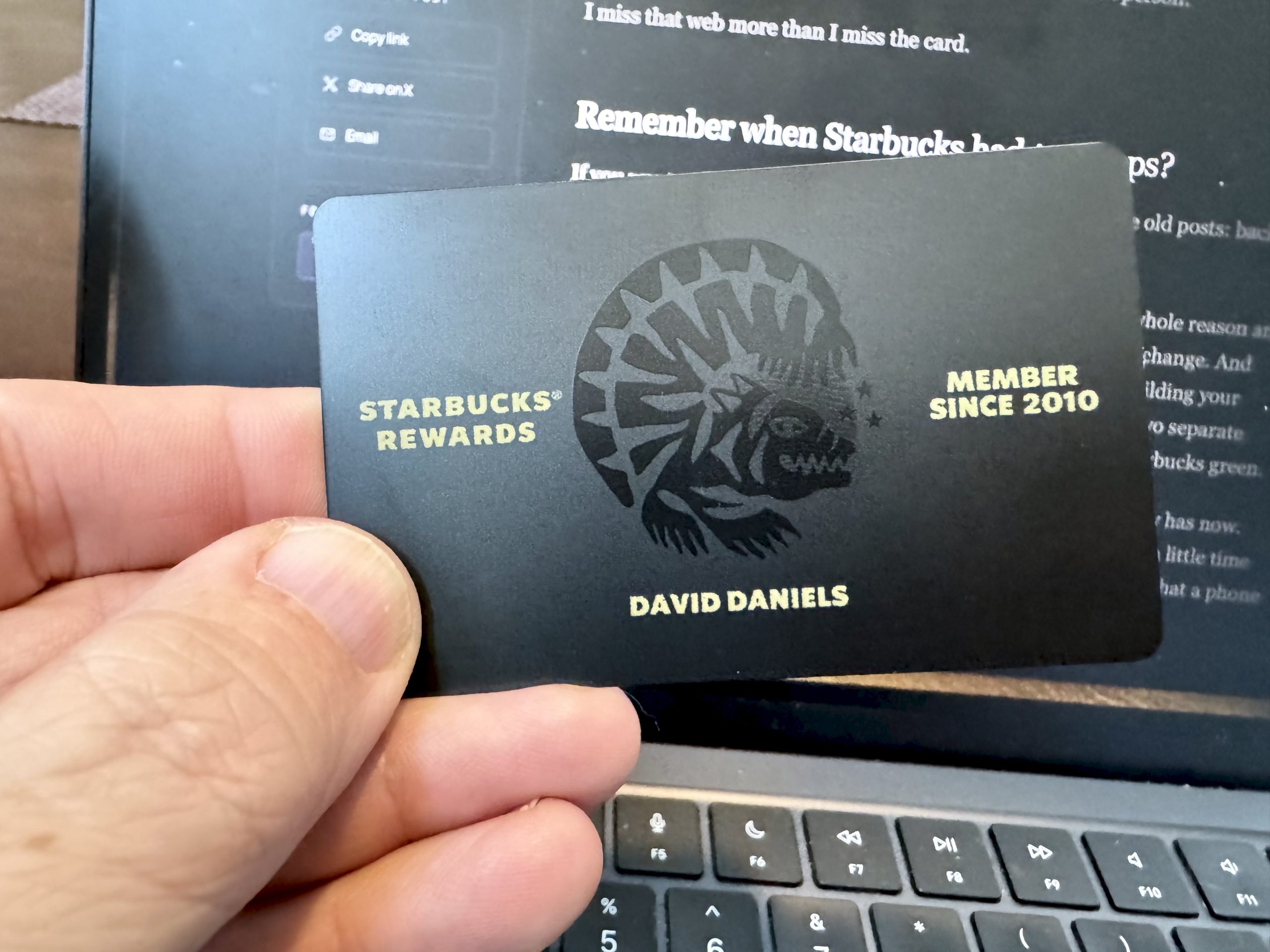
A black metal card landed in my mailbox this morning. My name is laser-etched across the bottom, and stamped on the right hand side are three words I keep coming back to: Member Since 2010.
So I went and reread what I was writing in 2010. Three posts, actually — a whole little saga about a piece of gold plastic. There was the impatient one, When Am I Getting My Starbucks Gold Card?, written in that antsy stretch after you qualify but before the thing shows up. There was Earning My Starbucks Gold Card Today, the day I crossed the line. And My Starbucks Gold Card — Finally Here!, where I documented the entire anticlimax and signed off by admitting I was now “walking around with a gold piece of plastic that signifies nothing really. Just that you are a coffee addict. Is there a cure for that?”
I barely recognize the guy who wrote that. He thought a gold icon updating on his iPhone was the future. He had no idea what the next sixteen years were going to do — to the web, to the phone in his hand, or to him. And that’s the thing about this new card: it’s the one part of the picture that hasn’t changed, which is exactly what makes it useful. Lay it next to 2010 and you can measure how far everything else moved.
Start with the wait
In 2010 the whole Gold Card showed up fast: earned March 13th, in my hands by April 5th. Three weeks, plastic and all.
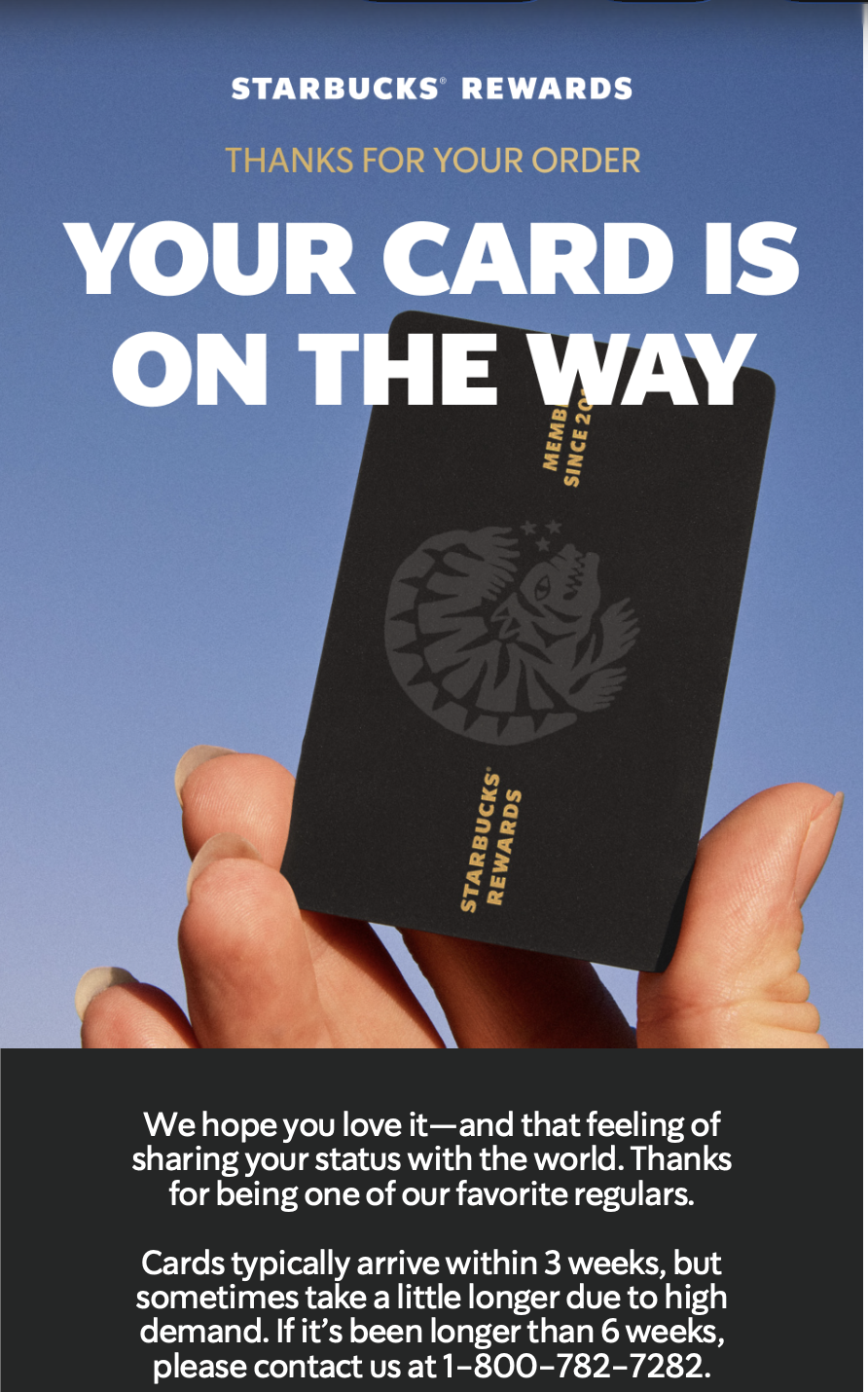
This time the “your card is on the way” email arrived March 27th, very pleased with itself, promising the card would typically turn up within three weeks and offering a 1-800 number if six weeks passed. Six weeks passed. So did seven, eight, nine, ten. It finally landed June 12th — about eleven weeks out, nearly double the point at which Starbucks itself invited me to complain. Everything else about being a customer got instant over sixteen years; I order and pay before I leave the house. The one object I could actually hold took the better part of a summer. Some things sped up, this slowed down, and neither is really what I came back to write about.
The web I was writing for is gone
Here’s what actually changed, and what I miss. Those old posts worked — they were some of the most-read things I published back then, and not because anyone came to my blog for Starbucks opinions. People were typing “when am I getting my Starbucks gold card” into Google, landing on some guy’s personal site who’d already been through it, and leaving with an answer. That was the whole web in one sentence: a small human question, answered by a small human on his own page.
That web is mostly gone now, buried under content farms and “everything you need to know about” filler. The 2010 me had no idea how good he had it. Sixteen years later I’m not really nostalgic for the gold card. I’m nostalgic for the internet it lived on.
Remember when Starbucks had two apps?
While we’re measuring distance: back then Starbucks didn’t have an app. It had two. One managed and paid with your card; the other was the lifestyle one, for finding stores and building drinks you’d never actually order. Two icons, two logins, both Starbucks green. They eventually merged into the single app everyone has now. At the time it felt like housekeeping. In hindsight it’s a time capsule — proof that nobody, not even Starbucks, had figured out yet what a phone was for. We were all just throwing apps at the wall. We’ve since figured out the phone. I’m not convinced that was entirely a win, but we figured it out.
The program grew up. So did the tab.
In 2010, Gold was something like thirty stars and a free drink every fifteen — a low bar I cleared one sub-$2 coffee at a time. Starbucks rebuilt the whole thing this past March: three tiers now, Green, Gold, and Reserve at the top, and Reserve takes 2,500 Stars in a single year.
Two thousand five hundred. That’s not a number you reach by accident. It’s a number you reach by being the same person, ordering the same kind of thing, on enough separate mornings that it quietly adds up to a decade and a half. The card isn’t measuring my loyalty to a coffee company. It’s measuring how long I’ve kept a habit.
The novelty went all the way around the track
In 2010 the exciting part was that the card had gone digital — I wrote an actual paragraph marveling at a gold icon appearing on a screen. Today the digital card is so ordinary it isn’t even part of the transaction. I don’t swipe, scan, or wave anything; the order’s placed and paid before I arrive, and the cup’s waiting with my name on it.
So how does a company make its best customers feel special in 2026? It mails them a metal card. In an envelope. With a real, lick-and-stick postage stamp on it.
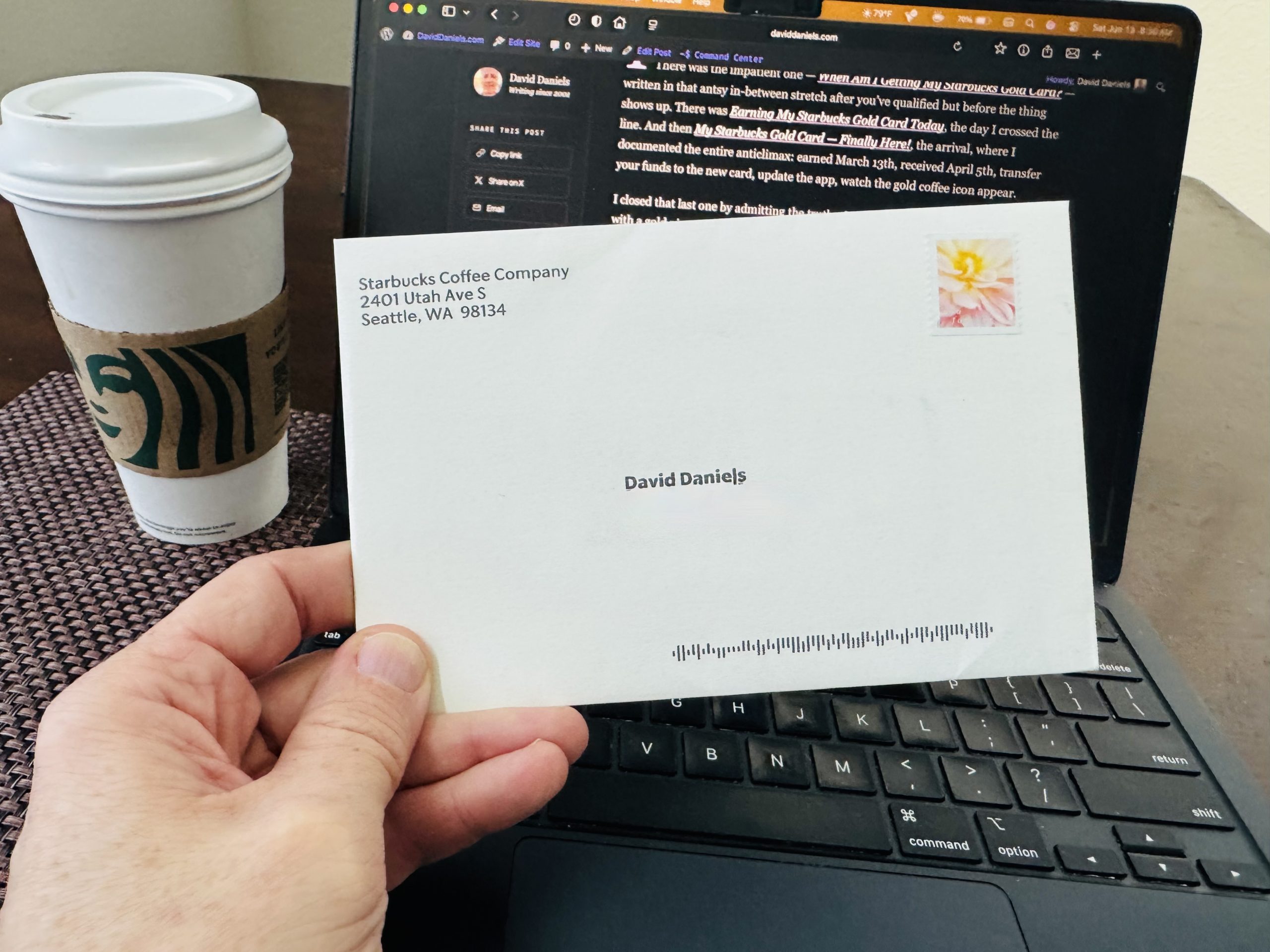
A stamp — the most analog object left in American life — ferrying a slab of laser-etched metal across the country to my mailbox. The thing that was magic in 2010 because it went digital is magic in 2026 because it came back to physical. Sixteen years to travel in a complete circle. If that isn’t the whole story of modern technology, I don’t know what is.
It disappears at the border
This card has logged miles. It rides in my wallet through airport security and customs lines, a little laminated piece of home. But the one trip it didn’t make was the big one — weeks working my way through South America — because down there it’s worth exactly nothing. So it stayed in a drawer, and I went without it.
I’d grown up assuming Starbucks was a fixed feature of the planet, somewhere between gravity and McDonald’s. Then you cross into a place where Juan Valdez rules the coffee world — where every corner has its own café and its own way of doing a morning cup — and you watch the green logo shrink to a curiosity. “The American one.” A thing tourists seek out for the familiarity, not a thing anyone local organizes their day around. Inside the United States, Starbucks feels like a colossus. Step outside it and the colossus turns out to be a national habit that mostly evaporates the moment you cross a line on a map.
That quietly reframed the whole thing for me. The card in my mailbox isn’t a passport to some global empire — it’s a membership in a very American ritual, one that’s enormous here and nearly invisible a few thousand miles south. The 2010 me thought he’d joined something huge. He had. He just had no idea how local “huge” can be.
What the card actually marks
I can hear the obvious question, because I asked it myself staring at all this: this guy is still going to Starbucks and still blogging about a loyalty card — has nothing changed in sixteen years?
Almost everything has. The web changed. The technology changed. I’ve stood in another hemisphere and watched this “giant” brand turn into a footnote. The city I live in, the work I do, the person typing this — none of it is what it was in 2010. The card is the one fixed point in the frame, and that’s precisely why I’m keeping it. Member Since 2010 isn’t a loyalty tier. It’s a timestamp — a ruler I can hold up against everything that did move.
And here’s the honest answer to the 2010 me, who wanted to know whether there was a cure for being the kind of person who fixates on a small thing and writes the whole thing down. There isn’t. But that question was never really about coffee. The going-to-Starbucks isn’t the point; it never was. The point is that I’m still the guy who stops to notice the small, ordinary stuff and bothers to make something out of it — and I’ve now got sixteen years of proof, stamped with the year I started.
Still ordering. Still writing it down. Just not the same person doing it.
The original trilogy, if you’re feeling nostalgic: the waiting, the earning, and the arrival.
David Daniels has been writing at DavidDaniels.com since 2001. Download the free life planning workbook, Write Open Act, to start mapping the gap for yourself.