The email from Apple
This morning, 11/8, around 3am eastern time, an email from Apple told me The Reading Room 1.2 had been approved for the Mac App Store.
I read it twice. Then I sat there for a minute, because I didn’t expect it to hit me the way it did.
I started this blog in 2001. Back then the internet felt like a neighborhood. It was very hard to find the early web users who were making their own websites. You found people by reading people. Somebody linked to somebody, and you followed the link, and a week later you knew a stranger’s dog’s name.
Somewhere along the way, that neighborhood got paved over. Everything that was originally being built was open. Twitter was based on RSS feeds, all websites had a feed and most anything could be followed through Google’s RSS Reader. But much of that disappeared so last month I started building my way back to it.
Why I built a reading room
You’ve probably heard the phrase “dead internet.” It’s the feeling that more and more of what you scroll past wasn’t written by anyone. It was generated, recycled, or tuned to keep you scrolling.
I didn’t want to argue about it. I wanted somewhere to go instead.
RSS has been around longer than most social networks. Almost every blog still publishes a feed, a simple list of its newest posts. A feed reader checks those lists and shows you what’s new, in order. No algorithm decides what you see, and nothing gets pushed up because it made someone angry.
I’d been using Feedly for years. It does the job. But I wanted something that felt like a quiet room with good light and a stack of letters from people I like. I almost called it Front Porch. In the end it became The Reading Room, with a tagline I keep coming back to: Written by people.
That tagline is the whole design brief. The app puts individual writers ahead of the big outlets. Your friend’s blog doesn’t get buried under forty headlines from a news site that posts every eleven minutes.
What it’s like to use
I’m the least objective reviewer this app will ever have but I did build it for me to use. So here’s what I’ve noticed after reading in it every day since October.
Adding a site is easy. Paste a website address and it finds the feed. Type a few words, like Starbucks, and it follows that topic as a news search. If you’re coming from another reader, an OPML import brings your folders along.
The reader is the best part. Click a story and you get the article itself, in clean type, with its pictures. No pop-ups, no autoplay, no cookie banner. If a site only sends a summary, View original opens the real page inside the app.
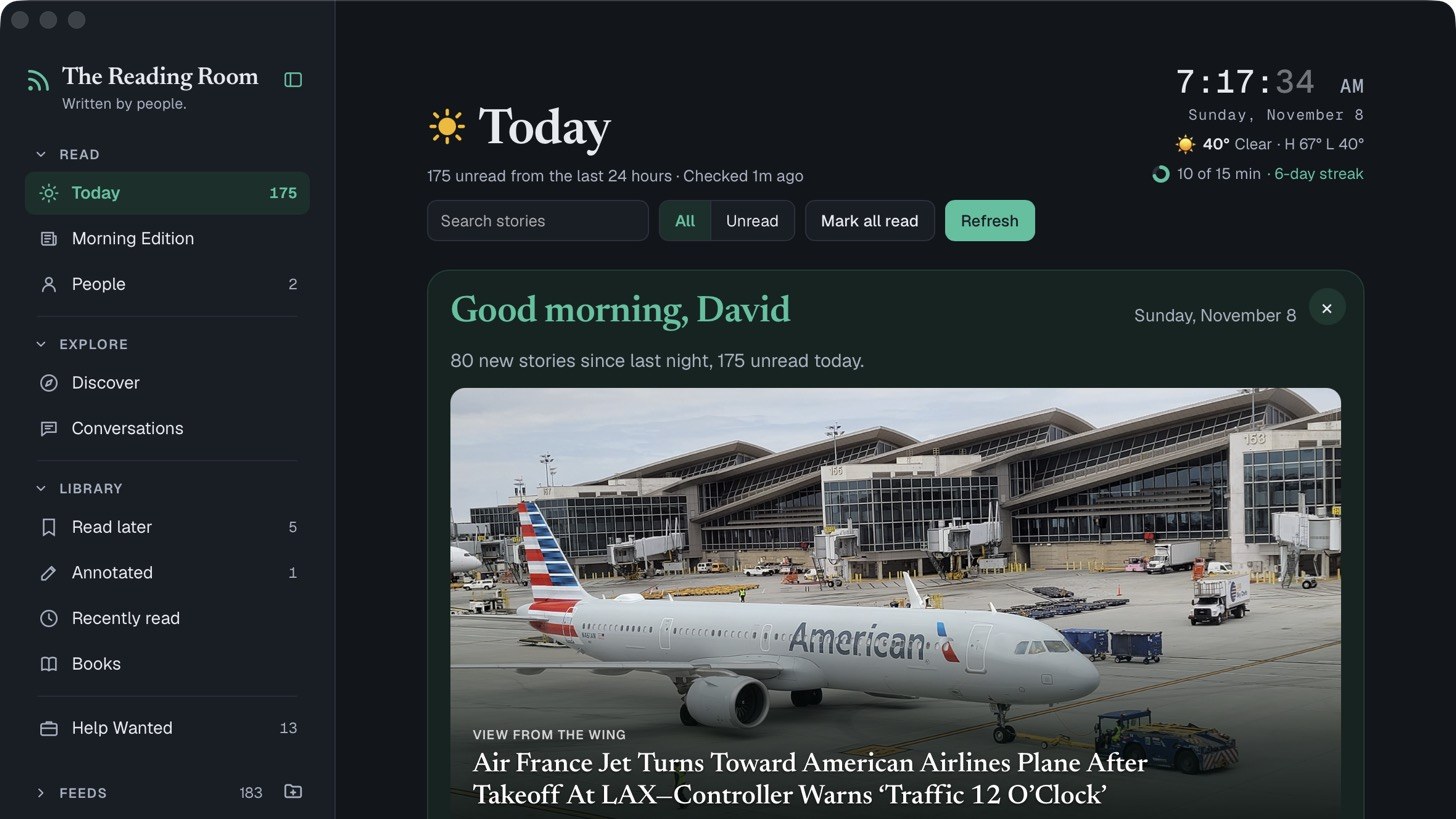
Today is where I start my morning. It’s a short briefing with the time, the weather and what’s new, with posts from people up front. On my iMac, the story list and the article sit side by side, and I move through them with j and k like it’s 2005.
Highlights and notes stay with you. Select a passage, highlight it, add a note. Everything you’ve marked up collects in one place called Annotated. For a blogger, that’s where the next post usually starts.
It’s private on purpose. No account. No tracking. No ads. Your feeds, highlights and notes live on your own devices. If you turn on sync, it uses a folder in your own iCloud Drive, and I never see any of it.
It’s on iPhone too. The iPhone version is already in the App Store, and it syncs with the Mac.
Now I am picking up the small stories from the indie bloggers again. A trip to Universal Studios in Singapore, A Grandmother passing away, weeknotes, side projects and even a topic that we can never discuss. I am picking them all up again and enjoying the web.
Where it falls short
A review that’s all praise isn’t a review. Here’s what I’d tell you over coffee.
I kept adding things. Books from Standard Ebooks. Audiobooks from LibriVox. A job board laid out like the classifieds. A newspaper-style Morning Edition that prints. Each one made sense on the day I built it. Together they push against the very thing I said I wanted, which was a calm room. The next few versions need to be about subtraction, not addition.
Some stories only show a summary. A few sites hide articles behind paywalls or build pages the reader can’t parse. View original handles it, but it breaks the spell.
Sync is simple, not clever. Each device writes a small file to your iCloud Drive and reads the others’. When the same thing changes in two places, the later change wins. It’s reliable, but it isn’t magic.
The iPhone version is a step behind. On iPhone, web pages open in Safari instead of inside the app, and moving feeds between folders uses a menu instead of drag and drop.
It needs other readers. I built it for me. An app about people needs more than one of them. That’s where you come in.
The verdict, and an invitation
Is it perfect? No. Is it the place I actually want to read every morning? Yes. For a builder, that’s the only review that counts.
The Reading Room is free, with no in-app purchases, on the Mac App Store and the iPhone App Store. App Store Link. Everything about it lives at readingroomapp.com, including a hand-picked list of personal blogs called Written by People that you can follow in one click.
If you’d rather try what’s coming next before everyone else, the beta is open on TestFlight. Tell me what breaks. Tell me what you’d take out. I mean that second one.
When I started this blog in 2001, I was writing for whoever happened to find it. Twenty-five years later I built a room for the people still doing that.
So here’s my question for you: whose writing would you follow if nobody could put anything else in front of it? Drop their name in the comments. I’m looking for my next favorite blog.
#Technology #Life #Nostalgia
Follow along — and other people still writing on their own sites — with The Reading Room, my free RSS reader for Mac and iPhone.