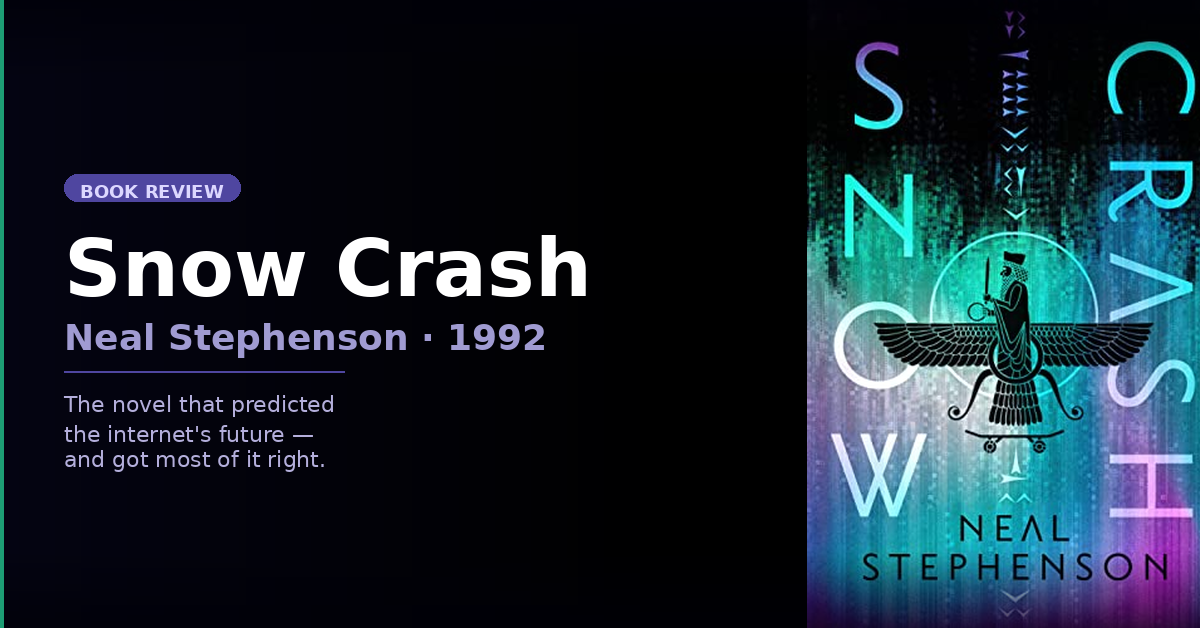
BOOK REVIEW
Snow Crash
Neal Stephenson (1992)
The novel that saw the future — and how much of it actually came true
In 1992, novelist Neal Stephenson sat down to write a cyberpunk story about a pizza delivery guy and an apocalyptic computer virus. He could not have known he was also writing a rough blueprint for the next thirty years of the internet. Set in a near-future America where corporations have replaced governments and reality is something you escape rather than inhabit, Snow Crash introduced concepts so prescient that Silicon Valley executives have been quietly treating it as a roadmap ever since.
The result is one of the most remarkable cases of technological prophecy in fiction. Some of what Stephenson imagined has arrived almost exactly as described. Some has arrived in a darker or more twisted form than he envisioned. And a few predictions missed the mark entirely — often in ways that are just as interesting as the hits.
"When I wrote this, the internet existed, but people didn't use it."
— Neal Stephenson, reflecting on Snow Crash in 2022
THE WORLD OF SNOW CRASH
Before getting into predictions, it helps to understand the setting. Snow Crash is a satirical, fast-paced novel set in early 21st-century Los Angeles. The federal government has collapsed into irrelevance. Power belongs to a patchwork of corporate franchises, private security firms, and religious cults. The hero, Hiro Protagonist (yes, that is actually his name — Stephenson is winking at you), is a gifted hacker who delivers pizza for the Mafia by day and spends his off-hours in a vast virtual world called the Metaverse.
The Metaverse is described as a single, impossibly long street running around the circumference of a black spherical planet. Users enter it via VR goggles and inhabit customized avatars. The quality of your avatar — and your access to exclusive spaces like the Black Sun nightclub — signals your social status. Sound familiar? It should. That description was written before the World Wide Web existed as a public technology.
The novel's central conflict involves a drug called Snow Crash that doubles as a computer virus, able to cross the boundary between the digital and the physical, frying the brains of users who encounter it in the Metaverse. Hiro and a teenage skateboard courier named Y.T. race to stop a tech mogul from deploying it globally. What makes Snow Crash endure, though, is not its plot but its architecture — the world it builds and the technologies it imagines.
WHAT STEPHENSON GOT RIGHT
The Metaverse
This is the big one. Stephenson coined the word "metaverse" in this novel, and the concept he described — an immersive, persistent virtual world where people live social and economic lives via digital avatars — is now a multi-billion dollar corporate obsession. Mark Zuckerberg renamed his entire company Meta in 2021 partly in tribute to this book's influence. Microsoft, Roblox, Epic Games, and dozens of startups are all chasing some version of the same idea.
1992 VISION: A shared virtual world on a single street, accessed via VR goggles. Social status determined by avatar quality and access to exclusive digital spaces.
TODAY: Meta (formerly Facebook) has spent billions building VR headsets and virtual environments. Roblox, Fortnite, and Decentraland all echo Stephenson's architecture — virtual economies, avatar customization, digital real estate.
There is an important caveat here, though. Stephenson's Metaverse was a dystopian escape hatch — something people fled to because reality had become unbearable. Zuckerberg's pitch positions his version as an upgrade, a joyful extension of life. Whether that distinction matters remains to be seen.
Digital Avatars
Stephenson felt the need to explain what an avatar was, defining it as an "audiovisual body that people use to communicate with each other in the Metaverse." In 1992 that explanation was necessary. Today, the concept is so embedded in everyday life — from gaming profiles to Zoom backgrounds to social media personas — that the original definition reads almost as comic. Avatars did not just arrive; they became foundational to how billions of people present themselves online.
Cryptocurrency and Virtual Economies
The Metaverse in Snow Crash runs on an encrypted electronic currency, and characters buy and sell virtual real estate with real money. Both of these ideas now have direct real-world counterparts in Bitcoin, Ethereum, NFTs, and blockchain-based virtual land markets on platforms like Decentraland and The Sandbox. Stephenson was so consistently ahead of crypto that he built similar ideas into several of his later novels, and he eventually co-founded Lamina1, a blockchain platform explicitly intended to provide the economic infrastructure for an open metaverse.
1992 VISION: Encrypted digital currency powers the Metaverse economy. Virtual real estate is bought and sold with real money.
TODAY: Bitcoin and Ethereum are now trillion-dollar markets. NFT platforms sold virtual land plots for hundreds of thousands of dollars at peak. The alignment is almost eerie.
Corporate Feudalism and the Gig Economy
Snow Crash imagines a world where federal power has fragmented and mega-corporations fill the vacuum, operating as quasi-governments with their own territories, laws, and security forces. Citizens are less employees than contractors — hustling between corporate fiefdoms with no stability and little recourse. This is not a perfect description of 2024, but it is uncomfortably close. The rise of Uber, Amazon, DoorDash, and platform capitalism more broadly has created exactly the kind of precarious, corporation-mediated labour market Stephenson satirized.
1992 VISION: Corporations replace governments. Workers hustle across competing corporate territories with no protections or stability.
TODAY: Gig workers drive for Uber, deliver for Amazon Flex, and rent via Airbnb — all within platform ecosystems they do not own or control. Tech giants exert political influence that rivals governments.
Information as a Virus
Perhaps the most chilling prediction in the book is the Snow Crash virus itself: a piece of information, transmitted through the Metaverse, that bypasses critical thinking and reprograms the mind. When Stephenson wrote it in the early 1990s, he thought of it as a clever plot device — a bit over the top. He has since admitted that watching misinformation spread virally on social media, watching algorithmic feeds polarize populations and erode shared reality, made him reassess. The metaphor came true, just without the literal brain damage.
"There was a couple of decades when I thought of that as just an interesting plot device, but a bit silly. Then the election of Donald Trump happened."
— Neal Stephenson, 2022
WHAT PARTIALLY CAME TRUE
Robot Dogs
In the novel, corporations deploy cybernetic guard animals called "Rat Things" — fast, mechanical, used for surveillance and enforcement. Boston Dynamics' Spot robot has been deployed by the NYPD, military contractors, and industrial facilities around the world. It is not quite as menacing as a Rat Thing, but the direction of travel is unmistakable. Give it another decade.
AI Assistants
Hiro's research companion in the novel is the Librarian — a self-aware AI with a human face and conversational manner, able to retrieve and synthesise information from a vast archive on demand. This clearly anticipates large language models like the one you might be reading this on. The Librarian is less capable than modern AI in some respects and more capable in others. What Stephenson got right was the conversational interface and the role of AI as a personalised research partner. What he underestimated was how quickly that would become a commodity available to everyone, not just elite hackers.
The Gargoyles
Stephenson describes a subculture of people who remain permanently connected to the Metaverse, wearing portable terminals and goggles at all times. They are nicknamed "gargoyles" because of how strange they look. This is a pretty good description of early Google Glass adopters — and a reasonable preview of where always-on AR glasses are heading. The social stigma Stephenson attached to public terminals (used by the poor) has also partly materialised in reverse: smartphone dependency is widespread but higher-end immersive hardware remains a status marker.
WHAT HE GOT WRONG
Social Media
Stephenson has openly admitted that he did not see social media coming. His mental model of mass media was still television. The idea that billions of people would produce and consume each other's content through distributed, algorithm-curated feeds was not part of his vision. The social dynamics of the Metaverse in the book are closer to a massively multiplayer video game than to Twitter or TikTok. This is arguably his biggest miss — and it turns out to be deeply connected to his biggest hit, since social media is what made the information-as-virus scenario real.
The Collapse of Government
Snow Crash depicts a near-total collapse of federal authority, with the United States dissolved into competing corporate franchises and ethnic enclaves. This has not happened. Governments have weakened in influence and credibility in many democracies, and corporate power has grown enormously, but the nation-state remains the dominant unit of political organisation globally. Stephenson's satire was sharper than his prediction here — he was exaggerating for effect, not forecasting literally.
The Physical Internet
In the novel, the global network enabling the Metaverse is a fibre optic monopoly controlled by a single tech billionaire. In reality, internet infrastructure is sprawling, multi-owned, and largely invisible to users — no single figure controls it, though a handful of companies come uncomfortably close. Stephenson's instinct about concentration was right; the specific mechanism was wrong.
THE VERDICT
Snow Crash holds up remarkably well for a thirty-year-old novel — not just as a work of imagination but as a piece of technological analysis. Stephenson understood something important: that the internet would not remain a tool for retrieving information but would become an environment that people inhabited, with all the social stratification, economic exploitation, and psychological manipulation that human environments tend to produce.
Where the book shines brightest is not in any single prediction but in its underlying model of how technology and power interact. The specific technologies have arrived in different forms than he imagined — VR headsets are still clunky, the Metaverse has not yet replaced the web, and no one has delivered a pizza via a katana fight in a virtual nightclub. But the economic and social logic he outlined — platform monopolies, digital escape from material precarity, attention captured and sold — describes 2024 with unsettling accuracy.
What makes Snow Crash worth reading today is that it functions as both a history and a warning. We are living inside a version of the future Stephenson sketched, and we are roughly at the point in the timeline where Hiro Protagonist is still figuring out who is building the virus and why. The question the book leaves us with is whether we will figure it out in time.
"Sometimes it is easier to see bad things coming than to see good things coming."
— Neal Stephenson
Snow Crash is available in print, ebook, and audiobook. Originally published by Bantam Books, 1992.
Here’s the Apple Books link for the ebook:
And if you also want to link the audiobook version, that’s at: https://books.apple.com/us/audiobook/snow-crash-unabridged/id393329802
David Daniels has been writing at DavidDaniels.com since 2001. Download the free life planning workbook, Write Open Act, to start mapping the gap for yourself.